Identity governance for AI agents and machines.
Rogue agents are the symptom.
Ungoverned machine identity is the disease.
Governthe Agents.Then the Estate.
The Non-Human Identity Governance platform for AI agents — and every robot, drone, POS terminal, and machine workload in your enterprise.
— Built by the team behind Difenda’s exit. Authors of the NHIG Standard.
Three verbs. One governed estate.
Discover.
Every AI agent, bot, certificate, and machine identity in your environment — read-only, no agents installed.
Govern.
Each one gets a named human owner, a scope, an expiry, and an audit trail. Inside a verified circle of trust.
Revoke.
When an agent is retired or has gone rogue, its access dies with it — across the entire estate, at the click of a button.
↓ Five pillars below — the full lifecycle Arkion governs.
The Non-Human Identity Gap.
For every human in your organization, there are 82 machines, agents, and services with identity credentials.
- None of them are in Okta.
- None of them are in Workday.
- None of them are in your IAM governance program.
This is the blind spot that ate enterprise security in 2025. It is the category we built Arkion to govern.
It starts with
one agent.
That is five non-human identities before breakfast — none of them owned, scored, or rotatable.
This is the blast radius of a single agent — compounded by every deploy, every rotation deferred, every team that shipped and moved on. It is not a security gap. It is an identity lifecycle debt that accrues interest.
You can't govern
what you can't see.
A redacted simulation of an Arkion ledger. Every row below is a non-human identity event — provisioned, scored, rotated, or quietly expiring — across the clouds where your agents already run.
Identity
lifecycle
debt.
A named liability. Quantifiable. Enterprise-owned. Non-optional.
Every agent you deploy issues credentials that outlive the deployment. Every service principal spawns a certificate that outlives the service. Every rotation you deferred is an orphaned identity with production authority — and no owner.
$4.45M average cost of a credential-related breach. $0 of which is recoverable from cyber insurance if the credential had no owner.
See the cost-of-inaction breakdown→Human IAM governs employees. It does not — and was never designed to — govern the machine estate beneath them. The gap between identity deployment and identity authority is not a security gap; it is a governance one.
A central source of identity for every non-human entity acting on your behalf.
Arkion is the central source of identity for every AI agent and non-human entity acting on behalf of your enterprise. We issue, rotate, and revoke those identities at machine speed.
With Arkion deployed, you can separate authorized AI agents from unauthorized ones, operate inside a verified circle of trust, and block any agent that has gone rogue or is no longer needed — at the click of a button.
“Rogue agents are the symptom. Ungoverned machine identity is the disease.”
You probably recognize at least one of these in your environment.
Claude Code, Copilot, or Codex deployed across 600 engineers. Holds an OAuth token with production write access. No expiry. No rotation. Currently un-owned.
A UiPath bot processing supplier invoices. Built in 2022 by a contractor who has left. Still authenticating to SAP every night.
An AWS IAM role with s3:* on every bucket. Created during a migration four years ago. Used by something. Nobody remembers what.
A POS terminal in a retail store. Holds a 2019 certificate. Ships payments to the gateway every minute. Auto-renewed once and never since.
An mTLS certificate on the broker between two payment systems. Expires in 6 days. Nobody on payroll today knew it existed.
Five pillars. One governed estate.
Discover
Continuous, agentless discovery of every non-human identity across cloud, on-prem, and SaaS — the orphaned, the unowned, the silently expiring.
- ▸Multi-cloud scan
- ▸Orphan detection
- ▸Estate-wide visibility
Every non-human entity gets an identity card.
The same way every employee in your company has a badge — issued, scoped, expired, revoked. Arkion gives every agent, bot, and workload the same structure.
Illustrative · not a customer record
Every cert, every API key, every service account, every workload identity — each one with an owner, a scope, a rotation policy, and a revoke button. All inside the same governed estate.
Arkion is a Certificate Lifecycle Management platform at its core — the same primitive that has powered cert issuance, rotation, and revocation for the SSL/TLS web. Built for a different workforce: AI agents, RPA bots, service accounts, machine workloads, and IoT.
The CLM you may already own was designed for web servers, load balancers, and mobile devices. Arkion was designed, from the first commit, around the identity an AI agent represents — its owner, its scope, its authorization, and its revoke button.
Read-only on day one. No agents installed.
Arkion connects with read-only credentials and returns a complete inventory of every non-human identity in the environment. No production change. No procurement cycle. From first call to first finding: 90 minutes.
Read-only IAM, STS, service-account, secrets, and certificate telemetry. Discovery, ownership mapping, and risk scoring run against your existing infrastructure — no agents installed, no data leaves your environment.
Roadmap items are scheduled, in scoping, or in private preview. Speak to engineering for the current quarter’s priorities.
A signed, exportable record of everything that happened.
Every Arkion estate produces a cryptographically signed attestation — board-presentable, audit-grade, accepted by cyber insurance carriers. Maps directly to DORA, NIS2, ISO 27001, and SEC Cyber-Disclosure. No screenshots. No spreadsheets.
See a sample attestation + the Compliance Crosswalk→Five questions every CISO and CIO should be able to answer in five seconds.
- 01Can you produce a list — by name — of every AI agent and non-human entity acting on behalf of your enterprise?
- 02Does each one have a named human owner who is accountable for what it does?
- 03Can you tell, in seconds, whether a given agent is authorized to be in production today — or has gone rogue, been retired, or was never approved?
- 04When an agent is retired or compromised, can you revoke its access across the entire estate at the click of a button — and prove it cryptographically?
- 05Do you operate inside a defined circle of trust — where every authorized agent is known, scoped, and accounted for, and everything else is blocked by default?
If any answer is “no,” “we’d need a project for that,” or “ask the team that owns it” — you have an Arkion-shaped gap.
Carriers are asking too.
Cyber insurance carriers increasingly require non-human identity governance for policy renewal — and refuse to cover breaches caused by orphaned credentials. Arkion produces the evidence carriers ask for: ownership for every identity, rotation cadence on every credential, signed event logs for every lifecycle change.
See the Compliance Crosswalk→Your estate, at a glance.
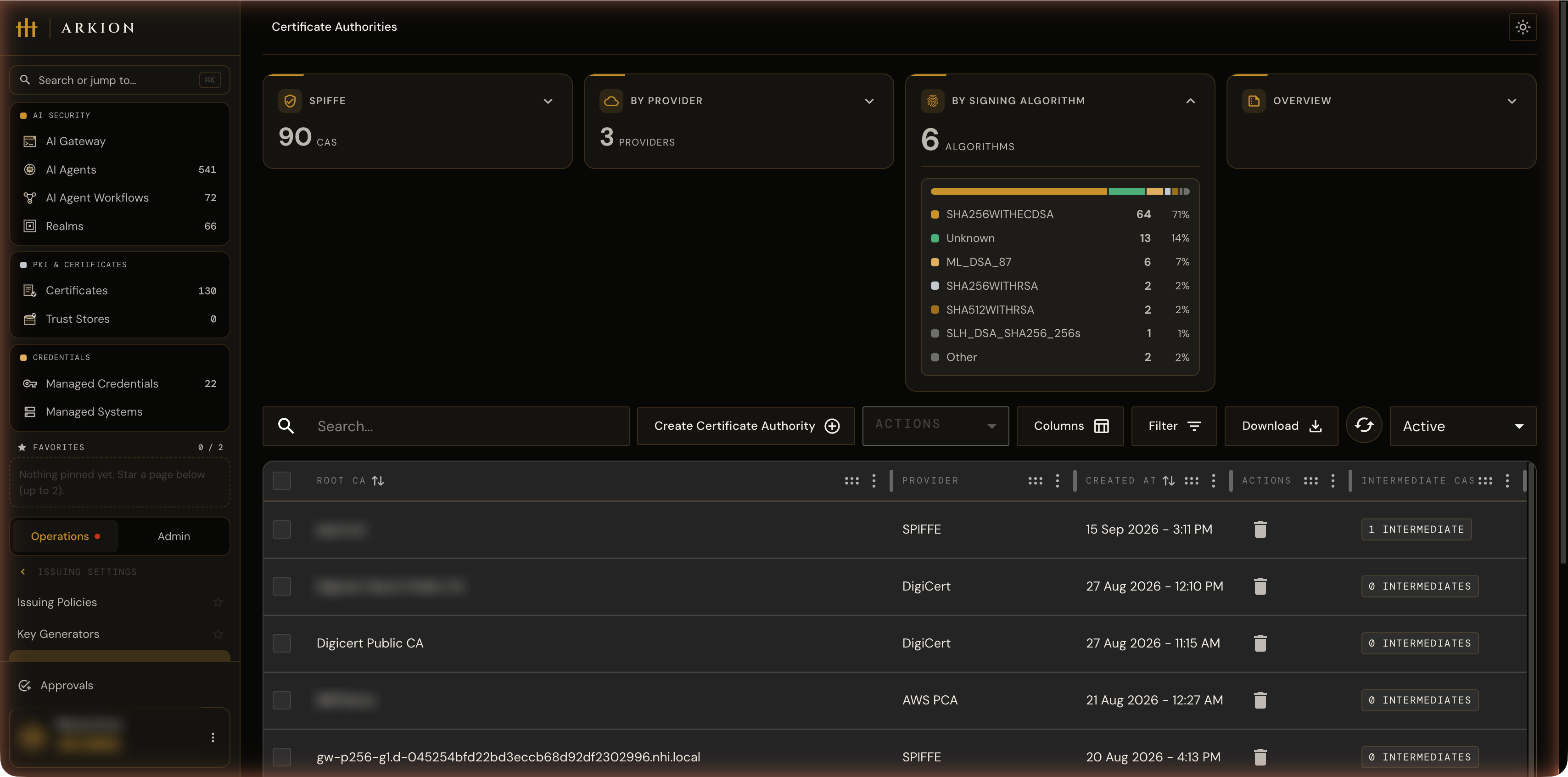
A single pane of glass across every non-human identity in your organization. Risk, compliance, ownership — continuous, cryptographic, unambiguous.
Everything your IAM missed.
Every certificate, discovered.
Including the ones your team forgot they issued. Passive log analysis and TLS telemetry surface every X.509 across your estate — known, unknown, and orphaned — with cryptographic ownership intact.
- Read-only enumeration · zero agents
- CT logs · TLS handshake · IAM API
- Owner inferred · risk scored · time-bound
Every AI agent, credentialed.
We don't just track AI agents — we mint the cryptographic identities they run on. From deploy-time provisioning through revocation, every agent in your estate carries an owner, a scope, and a cryptographic boundary.
- Deploy-time issuance · scoped credentials
- Tracked · revocable · auditable
- Built for autonomous & multi-agent systems
Workload trust, enforced.
Governed agents talk on mTLS. Rogue agents don't talk at all. Every identity is owned by a named human — no orphaned authority in production.
Lifecycle, never a fire drill.
Automated rotation before expiry. Owner-notified. Zero downtime. Every lifecycle event signed, timestamped, retained — DORA, NIS2, and SEC evidence is the ledger.
Risk, continuously scored.
Certificate health. Rotation state. Ownership. Behavioral anomaly. Four signals, one score, every identity — updated continuously across the estate.
See it in action.
A live walkthrough of the Arkion CLI. Watch a real scan, ownership lookup, and certificate rotation play out — no signup required.
From zero to
governed estate.
Four steps. One environment at a time. Every identity named, scored, and governed before the next begins.
Discovery Scan
We run a read-only scan of one environment — log analysis, TLS telemetry, and IAM APIs. No agents installed. No traffic intercepted. Results delivered to your inbox once the scan completes.
Engineering Findings Call
A senior Arkion engineer walks through every identity found: named, risk-scored, and specific to your infrastructure. You see the full blast radius before committing to anything.
Governance Policy Deployment
We deploy lifecycle policies, ownership assignments, and rotation schedules across your estate. Certificate issuance and mTLS enforcement activate within 14 days.
Continuous Governed Estate
Real-time risk scoring, automated rotation, and immutable audit trails run continuously. Your non-human identity estate is permanently governed.
Identity at the speed
of autonomous systems.
Your AI agents don't wait for provisioning tickets. Arkion doesn't either. Every agent receives a governed identity before it touches your infrastructure — not after an incident surfaces it.
Traditional CLM manages certificates in isolation. Arkion governs the full non-human identity lifecycle — discovery, ownership, rotation, and revocation — making it the first platform to treat NHI as a first-class governance primitive.
When a new AI agent is deployed, Arkion provisions its identity before the first API call — certificate-bound, owner-mapped, lifecycle-enrolled. No retroactive discovery required.
Arkion operates outside your workload runtime. No sidecar. No agent binary on your nodes. Governance is applied from above the estate — read-only telemetry in, policy enforcement out.
AI agents scale faster than any human team can track. Arkion matches that velocity — auto-rotating credentials before expiry, flagging orphaned identities the moment an agent is decommissioned.
EveryAIagentthattouchesyourproductioninfrastructurecarriesacryptographicidentity—provisionedatdeploy,scoredinrealtime,rotatedbeforeexpiry,revokedoncommand.Nosharedsecrets.Nostatickeys.Nogovernancegaps.
Every current platform has a structural ceiling.
| Capability | Human IAM PlatformsOkta · Entra · Ping · ForgeRock | Arkion NHIG |
|---|---|---|
| AI Agent Identity Governance | ✗Architecturally excluded | ✓Certificate-based, full lifecycle |
| Certificate Lifecycle Management | ✗Not supported | ✓Issuance · Rotation · Revocation |
| Orphaned Identity Detection | ✗Manual audit only | ✓Passive · log analysis + network |
| NHI Identity Registry | ✗No NHI model | ✓Owner-mapped, lifecycle-tracked |
| mTLS / TLS Telemetry | ✗Not in scope | ✓Passive handshake monitoring |
| Human SSO / MFA | ✓Core capability | —Not our space |
Human IAM governs your employees. Arkion governs your agents. This is not a gap they can close with a product update — it is an architectural mismatch.
Before you scan, estimate.
Two minutes. Seven questions. A directional estimate of how many non-human identities are currently operating outside any governance boundary in your environment. No data leaves your browser until you submit.
- 01EmployeesSet your headcount band
- 02Cloud estateAWS / Azure / GCP / on-prem
- 03AI agentsNone → autonomous multi-agent
- 04RotationAutomated → rarely / never
What we
believe.
Machines cannot use passwords.
Every human IAM control — MFA, rotation prompts, session timeouts — assumes a person at a keyboard. Non-human identities require a different substrate.
Certificates are the only governable primitive.
Cryptographically bound, time-limited, programmatically rotatable, instantly revocable. No other credential type satisfies all four properties.
Discovery must be read-only.
A platform that writes to your infrastructure to discover identities has already failed its first trust test. Arkion never modifies the estate it governs.
Every identity needs an accountable owner.
An orphaned agent is a standing privilege with nobody responsible. Ownership mapping is not a nice-to-have — it is the precondition for governance.
Compliance is continuous, not quarterly.
ISO 27001:2022, NIST CSF 2.0, DORA, NIS2, SEC cyber-disclosure — each demands evidence of identity governance. Arkion produces immutable, cryptographically attested audit trails in real time, not spreadsheets before a review.
Governance must be provable.
An assertion is not evidence. Every lifecycle event in Arkion is signed, timestamped, and retained in an immutable ledger. When the auditor asks, the answer is already waiting.
May · 2026
7 min read
The Trust
Boundary Problem.
Legal accountability for downstream agents now flows upward. The technical authority to govern them does not.
Every prime contractor, parent bank, and hospital network is legally responsible for agents acting under their authority — and operationally unable to revoke them at machine speed. CMMC, OSFI B-13, and NIS2 are converging on the same requirement: technical authority must match legal accountability. Existing IAM cannot deliver it. We're researching what does.
Read the Field Note→See your
governed estate.
Read-only. One environment. We come back with every non-human identity found — named, scored, and specific to your infrastructure.